Wednesday, September 3, 2014

Focus Stacking to Extend Depth of Field in Landscape Photography


Nikon's 105mm F2.5 Ai lens coupled with focus stacking enables simple extension of depth-of-field for this image of a beautiful little cascade in American Fork Canyon in Utah's Wasatch Mountains.  The cascade is the result of one of many natural springs in the mountains.  When the winter snow melts, in the spring, most of the water flows down the canyon's river but some of percolates INTO the mountain collecting in the faults there.  This water eventually finds its way outside the mountain at some lower elevation results in the many springs in the area.  The springs flow, throughout the entire year, at a constant rate resulting this lush green little cascade.  The actual spring is about 50 feet above the cascade.

The images for this "Stack" are collected using the 105 F/1.2 Ai mounted on my Nikon D800E camera, supported on a tripod of course.  I find that the large focus throw of this manual lens easily facilitates focusing at multiple locations in the scene, stepping from the foreground to the background.  This particular set of images were collected early in the morning.  The air was very still with essentially no breeze.  The camera was set at F8 and ISO controlled to achieve the shutter speed so that the flowing water is smoothed as desired.  Zerene Stacker allows editing of the images to assure that the water at each in-focus region is selected appropriately.  Since the air was calm, the only thing moving was the water.  Editing was done in a couple of minutes.  Once practiced, the entire process is easy to perform.  I actually practiced this at several times during the spring, to select the motion blurring the water I desired and pick a time when the spring flowers were at a peak.  There is a little bird on the moss.  Can you find it?

Beautiful little Spring-fed Cascade - entire Depth in Focus


Monday, July 28, 2014

Use of Focus Stacking to Extend Depth-of-view For Landscape Images

(Colville's Columbine)


In June of each year, I become interested in photographing Coville's Columbines in alpine settings near our home and capturing their complex shape.  To me, Columbines are simply wonderfully beautiful flowers.  They also present an interesting photographic challenge.  Their structure is "three-dimensional" in nature.  Unlike a sunflower, for example which, if shot face-on, is basically two-dimensional, Columbines have long tail-like structures which project behind the blossom.  No single photograph can capture this 3-D nature.  One could, of course, pick a single blossom and photograph is from multiple angles but there is an alternative.

Up behind our home at an elevation around 8,000 ft there are many many of these blossoms.  One morning, I found three blossoms aligned in a row.  They were all new and fresh, one faced directly forward, one rotated about 45 degrees and one about 90 degrees.  The Nikkor 105mm F2.5 Ai manual focus lens mounted on a D800E was a great tool for what I wanted to accomplish which was to show the 3-D structure of this flower.  The 105/2.5 Ai is a wonderful lens, with excellent bokeh and a large smooth focus throw.  With the camera on a tripod, at the distance where all three blossoms were in a single image and at F8, I captured three images, focusing on the yellow stamens for each blossom in turn.  The three images were then combined using focus stacking to produce a single photograph of all three blossoms, all in focus.  Its simple and quick and no need to move focus points or worry about the two side blossoms at a location where autofocus sensors could NOT be placed on the stamens without moving the camera.

The results are shown below.

3-D Structure of Coville's Columbine (Please View Large)


Monday, June 25, 2012

Focus Stack of a Salvia


I saw this flower last spring and have tried to get acceptable photographs with a single shot.  I do not want to shoot it directly on but still wish to see the full depth of all of the spikes and I want the background to be highly blurred.  The weed is generally mixed in with other grass so the background tends to be busy and distracting, so focus stacking was an ideal alternative.  Neighboring blossoms are seen nicely out of focus.  I utilized Zerene stacker to generate the composite.  This program has a helpful editing capability which came in handy to pick a single image with the best shot of the fly and make sure that it is used in the composite.  Nice feature.


Tuesday, June 19, 2012

Focus Stacking for Macro and Close-up Photography

Focus stacking is a relatively new digital photography technique which can, to me, produce startling results.  To generate the images shown here, I utilized a focusing rail (Novoflex - Castel-L), my D700 camera and Nikon 105mm VR II lens combination, a steady tripod and Zerene Stacker software.  Since, I am interested primarily in outdoor photography, I also now use some sort of mechanism to steady the target.  A breeze is always blowing. 

I always operate in the Manual exposure and focusing mode.  The camera is arranged the appropriately aimed at the target and manually focused in LiveView mode to where the focus plane is just before the target and the first image is collected and then advanced in steps moving the focusing plane through the object collecting multiple images.  The step increment is selected depending on the depth of field.  Once collected all images are then processed identically.  I generate Jpegs and the resulting stack is input into the software which creates an image made up of "in-focus" portions of each image.  In this way, one still has the advantages of a sharp DOF fall-off in front of and behind the first and last image combined with a large DOF. 

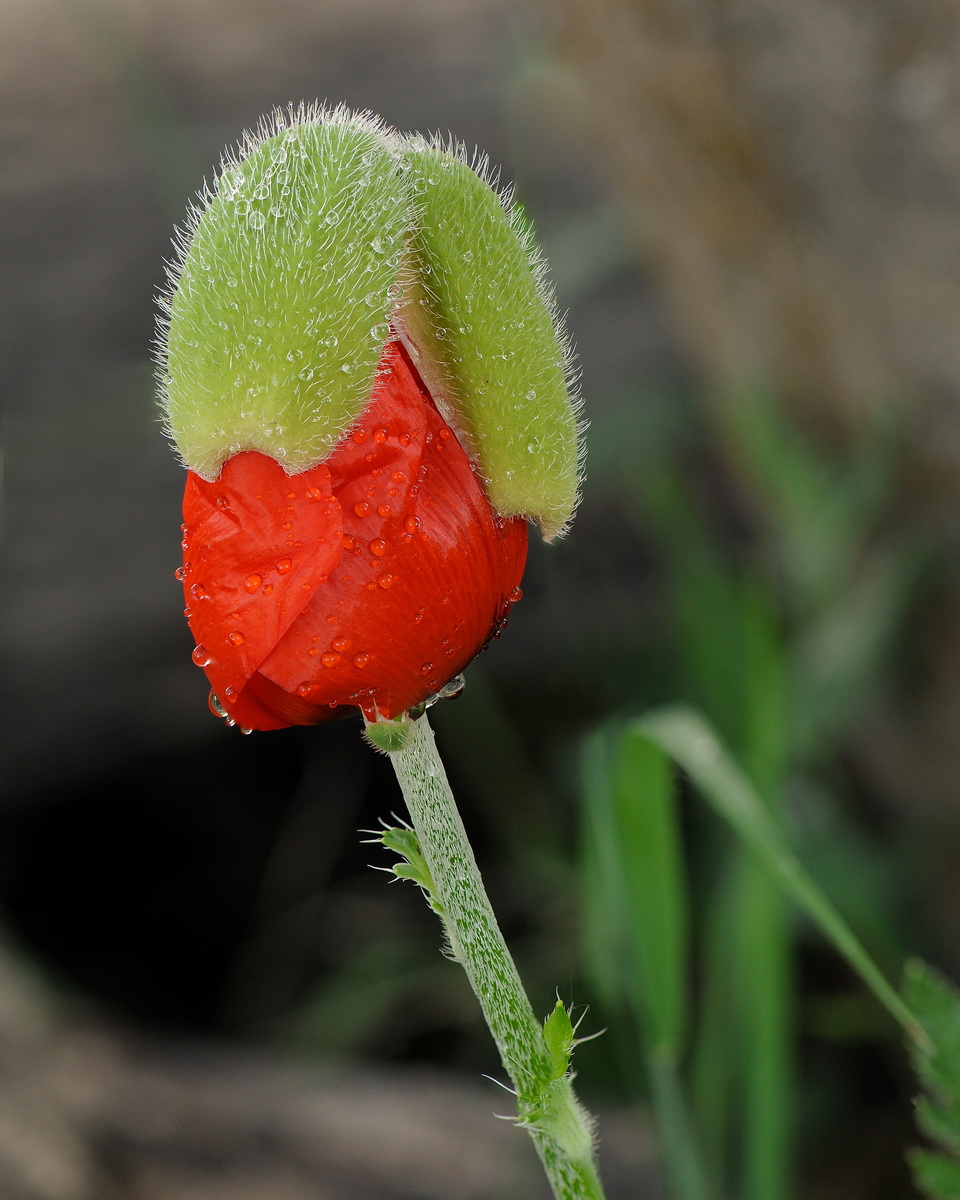
The first image is a stack of 30 images of a Poppy which is just blooming.  The resulting images are still startling to me.  One sees how each image plane is in focus as the rail is used to step through the scene, but the entire scene only becomes "in-focus" as it is processed.


To me the detail is just stunning.

The next three images are stacks of Thistle blooms.  I searched for plants which had bright Magenta coloring.  The first image is a close-up of the blossom which is just about to emerge.  The focus distance was relatively close, so the DOF is narrow and about 50 slices were collected.

The second and third images were of a wider view and fewer images were needed. 


As with both Macro and Telephoto photography, what one sees with the naked eye and through the lens, is strikingly different but with stacking the difference is even greater.  Through the macro lens, one sees the magnified scene but only a narrow region is in focus.  When all put together by the software, the results show all the detail in each image.  It really is amazing!

Friday, May 20, 2011

Abandoned Mine - Historic Tintic Mining District

Discovered this abandoned mine near Eureka, UT in the eastern slopes of the East Tintic Mountains overlooking Utah Valley.  The first image shows the overburden piles of yellow to orange rock.  The stone leaches so there is a pool of deep orange water from the recent rains in the area.  The age of the Juniper trees growing in the overburden indicates that this mine has been abandoned for many years. 


Two images of the structure covering the entrance to a mine in the same area.  There are active mines nearby, notably the Trixie silver and gold mine which is still active.


Tuesday, May 17, 2011

Grain Elevator in Utah's Tintic Valley

This abandoned grain elevator is just off the State Route 36 near Eureka, Juab County.  It's just off the side of the road adjacent to the UP railroad tracks.  Its completely out of place.  There is nothing nearby.  Obviously,  it draws the attention of graffiti artists and has for some time. 

The clouds were great.  I use my 12-24mm DX lens on my D700 shooting in the FX mode and just never go wider that 17 mm and it works fine. 


Friday, May 13, 2011

Bridal Veil Falls in Utah's Provo Canyon

Images of Bridal Veil Falls, Provo Canyon, UT.  I slowed the shutter speed by using a 64X neutral density filter from B+W.  I also moved as far away from the falls as reasonable, almost back to the main highway in Provo Canyon.  This moved me up and made the upper reaches of the falls more visible.  The snow pack on the Wasatch Mountains is way above normal so a fair amount of water is coming down the falls.  I used my 70-200 MM lens which allowed my to zoom into the see the details of the lower falls.

Details of the lower falls


Saturday, April 30, 2011

Andrew on the Salt Flats

Andrew is a trooper.  He seems to tolerate endless photos.


His dad is taking  a DSLR movie and he looks at grandpa.

Oh boy will this ever end?


OK, I'll pose.  I used a small amount of fill flash to what I think is good effect.

Wednesday, April 20, 2011

Allison on the Bonneville Salt Flats

For Spring Break, we took the kids to the Salt Flats near Wendover, UT.  This shot is actually on the Bonneville Speedway which is deserted this time of the year.  Speed trials start after the surface dries out.  Allison is a pro at candid modelling.  Just let her do her things and try to get a great shot.  Took the chairs as props for this white plain.  Fortunately, there was cloud cover, because there is a lot of light like with snow.  

Saturday, March 26, 2011

Abandoned Log Cabin - Duchesne Utah

This small log cabin is located in Indian Canyon a few miles south of Duchesne, UT.  Ranching is still done along the creek in this small canyon.  This cabin, an out building and ramshackle corral is located on this property. 

Mount Timpanogas After a Snow Storm

Photo taken of Mount Timpanogas on the morning after a winter storm.  Black and White conversion using SilverEfex Pro. 

Sunday, February 6, 2011

Sloane's Smile - Eye Teeth Coming in First

No posing just an infectious smile!  Her eye teeth are coming in before her front teeth, sort of a vampire like look.  Stand her up against the blue wall, have her mother get her attention and she breaks into spontaneous enthusiasm.  No posed stiff expression here!

Sloane is Almost One Year Old - She is a Pistol!

Sloane is almost one year old (Feb 11th).  What a doll.  The primary touch-up was to remove black specks of dirt around her mouth.  Like her siblings, she is blessed with a great set of very dark eyelashes!  No problem getting her to show excitement.  Getting her hold still is another thing.  Get the shutter speed up.

Allison Steals the M&M's Intended as Posing Bribes


Allison helps herself to the bribe M&M's.  Caught one piece of candy in the air.  Look at those eyelashes!  

Emma Deming

Portrait of Emma.  She likes this hat, although it is not a favorite of her mother.  The key light is a large window to the right with a reflector to fill from the opposite side. 

Saturday, February 5, 2011

Front of the Provo Tabernacle Burns on December 17th, 2011


This is the front door of the Tabernacle which faces east to University Avenue in Provo.  The rubble of the roof and balcony block the doorway and then flames continue.  The pretty stained glass windows are visible in the photograph.  The four cornered spires of the Provo tabernacle are modeled after the Assembly Hall on Temple Square in Salt Lake City.  The LDS church no longer constructs building of this nature.  It was originally the large meeting house for all of Utah County and has served place for both church and cultural events since is was completed in the 1860's.

Still Burning North Wall of the Tabernacle


The wooden rubble is still actively burning some 12 hours after the fires started and after many hours of dousing water on the building.  The pews, including a large balcony on three sides of the  of the large meeting room were all constructed of wood.  The wooden roof, balcony and pews meant there was a large amount of combustible material which continued to burn for hours. 


This fireman, Glassford, is photographing the burning rubble through the doorway in the north wall.  Hot spots would continually erupt so the fire department would direct water to hold down the flames. 

Three Renderings of the South Wall of the Tabernacle


Color photograph of a stream of water directed at the south wall of the building.  The temperatures were below freezing so the hose water covered trees with a heavy coating of ice.  The second floor stained glass windows have been destroyed. 


Monochrome rendering of the above image which has been pre-filtered using a blue filter so that the orange brick goes dark and the visibility of the stream of water is enhanced.


Second monochrome rendering using an orange filter.  So the brick appears light and the smoke covered bricks above the windows appears dark.  All B&W rendering are done in CS5 using Nik Silvereffects Pro. 

Provo Tabernacle from the East

The largely destroyed eastern facing front of the Tabernacle.  A B&W rendering shows the smoke still rising from the building center.  By this time the roof and wooden structure inside the building had collapsed in heaps which were still on fire.  The tabernacle was built and owed by the LDS church.  Initial construction was begun in the 1860's with several upgrades over the years.  The building was still in use both for church and community activities to this date.  

Provo Tabernacle Desroyed by Fire


Photograph of the still burning Provo Tabernacle at around 1:30 pm on the 17th of December, 2011.  The building had been burning almost 12 hours since early morning.  The Provo Fire department was pouring water on from multiple directions and the wooden interior of the building was still actively burning.